Jump to tech industry insights
Jump to sales and marketing insights
Jump to HR and talent acquisition insights
Jump to accounting and finance insights
Jump to general workforce insights
Ireland is nearing full employment once again, which means there is a shortage of candidates rather than a shortage of jobs, and employers are vying for the best talent. But which areas are suffering from the greatest shortages? What skills will become more important than ever in the new year?
Due to the battle for top talent, our 2020 Salary Predictions Guide expects salaries to rise in the industries for which we recruit. However, with the impending consequences of Brexit still to come, employers are braced for tough times and this will likely show in some ways in their hiring decisions. Having said that, trends and evolving needs will continue to demand certain skillsets and employers will need to respond to these demands.
Unsurprisingly, technology will dominate next year, both as an industry and as a growing element within other jobs markets meaning that, the wages in the tech sector will continue to rise. According to LinkedIn’s 2020 Emerging Jobs Report, AI is a top priority in jobs markets all over the world. Our daily interactions are becoming more automated all the time and this has led to artificial intelligence specialist being the number one emerging job in the UK as well as a number of other countries. Additionally, many US tech firms have been opening Dublin offices in the last few years and this is likely to continue
Additionally, GDPR implementation and increasing regulatory practices has already led to a number of roles in data protection and cybersecurity and it will continue to increase in 2020. However, the need for soft skills has never been more important as we head into another year of fighting to attract and retain the best talent. This will not only change how candidates market themselves in any industry, but it will also change how HR and talent acquisition teams work. As an industry, HR will be looking more for those with L&D backgrounds in order to retain good talent and upskill them to keep them engaged. Below, we look at industry-specific trends to give a more accurate picture of what we can expect in 2020.
Download 2020 Salary Predictions Guide
The tech industry is booming as the need for workers in core areas such as software development but, according to a new report from Udemy, there is also a huge appetite for AI and data science skills as well as web development frameworks, cloud computing and other IT certifications.
The report said that “2020 is the year that AI goes mainstream”, which means that it has bled into almost all industries by now and will come as no surprise to those who work specifically in the tech sector and have been watching the demand for AI-related skills rise year on year. Additionally, in LinkedIn’s report on emerging jobs for Ireland in 2020, AI specialist came out on top, with data scientist, cloud engineer and DevOps engineer all making the top 10.
In speaking about the tech industry outlook for next year, RECRUITERS’ Al Keogh said that cloud experience will be important and “people with AWS, Azure or Google Cloud experience are and will continue to be in high demand.” Additionally, network engineering, IT leadership around cloud strategy and site reliability engineers will all be in high demand in 2020.
Additionally, Keogh said that Python is continuing to grow in popularity. Python has been a popular programming language for some time now, mainly because it’s user-friendly, flexible and can be used for most things in the industry. However, that doesn’t mean that other languages are falling by the wayside. Last year, we talked about why demand for Java developers was actually on the rise because it’s cross-platform functionality. And while there has been a lot of discussion recently about the possible decline in Java’s popularity, it is still one of the top five programming languages for AI, which is going to become extremely important in 2020.

So, will Python’s growing popularity beat Java in the new year? Keogh believes Java will still be extremely important, especially when it comes to scaling up. “It is true that you have to write more lines of code in Java to do something than you would have to do in the likes of Python,” he said. “It is a much quicker language to code in, but Java is much more scalable. That’s why enterprise sites use it and, in that respect, it’s not really going to go anywhere.”
With demand for tech skills on a steep incline, employers will need to look beyond traditional talent pools. Additionally, a lot of tech talent in Ireland comes from overseas and employers should be optimistic about this when it comes to finding talent. Ireland continues to attract the talent from overseas because of the chance to work in an English-speaking environment and the career opportunities available. However, work permits and visa concerns have often been a barrier for employers when it comes to hiring talent from outside the EU, but this shouldn’t be the case as it’s one of the strongest ways to combat the talent shortage.
Another growing trend within the tech industry is the growth of the contingent workforce. According to Keogh, engineers are looking to work on a contract basis. “Companies willing to hire contractors are more able to attract the talent they need.” The growth of contract tech workers is not just candidate driven, but employer driven too. In fact, a 2017 Randstad Sourceright report showed that more than 60% of employers planned to replace one-third of their permanent staff with contingent workers.
In our 2020 Salary Predictions Guide, we predict salaries in the high-tech industry to increase by approximately 8% due to the intense demand for talent. However, specifically in the software engineering space, we expect salaries to rise even more, due to the high barriers to entry and the even higher skills shortage.
While the world is evolving and changing many industries, the sales industry has been a constant need, although it has become more sophisticated over the past decade. Now, marketing and customer success are tied into the sales funnel and the growth of inside sales and technical sales has changed the industry massively.
In her 2020 sales trends outlook, sales and marketing recruitment manager Patricia Lynch, says she expects 2020 to be similar to 2019 with the continued high growth in the tech sales space, especially with more tech companies choosing Dublin as their EMEA location. “I’d expect to see an even higher demand for multilingual candidates in this sector, in particular German, Nordics and French.”
The growth of inside sales centres means the demand for talent in this area is enormous and has been for the last five years. In fact, according to HubSpot earlier this year, inside sales made up 43.5% of professional salespeople in 2017 and was expected to grow by more than 4.5% this year and eventually moving towards a 50/50 balance of inside and outside sellers.
Demand is strong as more and more EMEA sales centres open here, especially in the high-tech arena, which are driving sales around EMEA from Dublin and utilising our multilingual, well-trained workforce. This also means the need for tech sales talent is growing and while traditional sales professionals are upskilling to fill that gap, there is a shortage, which means a well-rounded candidate can command a more lucrative salary, especially if they have experience in technical sales.
‘Within marketing you’re expected to be first to the table with usage and driving further uptake’
As marketing elements blend into the sales funnel, marketing in itself has become far more sophisticated than ever before, having gone through a huge digital transformation in the last decade. Organisations are looking for more leads through market research and digital marketing efforts. In fact, Zenith’s Advertising Expenditure Forecasts says spend on social media is set to rise 20% this year, causing it to overtake print to become the third largest ad channel, followed by TV and paid search ranks, which also highlight’s the growth of digital marketing.
For anyone looking for marketing jobs, data has become more important than ever. Data can increase customer acquisition massively and at a time when marketing is focusing heavily on digital and blending into the sales funnel, acquiring new customers in a measurable way will be key in 2020.
In fact, associate principal marketing recruitment consultant Louise O’Reilly said early, middle or advanced-stage marketers in any way inclined towards analysis, analytics or proof by numbers are well positioned. “It’s advisable to become more familiar with the tools and systems in use in analysis, CRM, automation and digital because that is what companies are seeking even to complement traditional non-analytical roles,” she said.
“The content creator or events manager in B2C retail needs to track and prove engagement and results as much as the demand gen manager in B2B tech. Organisations are implementing sophisticated systems throughout and so within marketing you’re expected to be first to the table with usage and driving further uptake.”
Digital marketing tactics are becoming more valuable to all businesses due to their targeted, measurable nature, which means demand generation marketers and marketing operations experts who are familiar with a variety of tools have already grown in demand and will become even more of a hot commodity next year. In fact, O’Reilly also spoke this year about the ways in which marketing professionals are moving within the industry at the moment and it’s to do with developing those key skills that are becoming more in demand, specifically B2B marketing, tools they’re not familiar with.

Content is another major growth area as the new PR, and demand is met again by a supply of more traditional writers, journalists and editors keen to move across. Certain new roles such as marketing technologists and marketing engineers are becoming more common place as is the world of product management morphing more toward a marketing bias for certain categories of roles.
HR and talent acquisition have been splintering apart for some time now, particularly in bigger companies, leaving talent acquisition teams to focus solely on what their title suggests, while those strictly in the HR space have more room to develop more long-term organisational strategies.
The growth of internal talent teams and workforce planning analysts has seen a huge jump in the last four years as companies look to grow. HR professionals will require skills and experience in the latest HR tools and as the remote and contingent workforces become more common, experience working with both will become more important.
Similar to both sales and marketing, data and analytics is a key function to HR and will continue to be so in 2020. Data in HR is not a new concept but having the tools in place to ensure you’re using that data in the best way possible has become more important than ever and HR tech has advanced massively in recent years to facilitate this.
Additionally, there is a third potential split within the HR function in the L&D area as career development becomes paramount to retaining top talent. Companies are now more focused on holding onto the employees they have and building up internal talent, rather than recruiting for fixed roles and replacing them when necessary. Aside from the fact that this is extremely costly, a company that nurtures the staff they have, supports L&D and is interested in promoting their employees will not only keep them loyal, but it will attract additional talent.
As we head into 2020, L&D has become extremely important. Skills mapping will chart the future workforce, bringing analytics into the mix and measuring capabilities in a more focused way rather than ad-hoc training. We expect the L&D function will continue to build out and transform in the few years.
Looking at the HR industry in 2020, managing director Gerard Doyle said employers should and will seek HR professionals that can take a more holistic view of what their workforce needs. “HR professionals with a capacity for managing change and developing middle and senior line managers with a blended learning approach are in high demand.”
In the past, employees may have felt that the HR function within their business is somewhat disconnected to the rest of the business and therefore out of touch with how employees really feel and so cannot sufficiently keep them engaged and happy. But as titles within the HR industry change and evolve to names such as ‘chief happiness officer’ and ‘director of culture’, it is clear that the future of HR professionals will be very much embedded in the centre of the company culture and will be tied to the satisfaction of its employees.
2020 and beyond will be an exciting time for HR with new technologies and tools becoming part of their day-to-day tasks all the time and the splitting out of roles giving more time for niche-specific professionals to really thrive, be that in L&D, talent acquisition or organisational strategies.
The barriers to entry remain lower in HR compared to technology or finance, but it remains an attractive area for people to work in due to its people focus, especially given the new specialist skills it will require in the areas of employee experience and employer branding.
Apart from the tech industry itself, the accounting and finance industry is probably the most affected by the technological revolution over the past number of years. Advancements in technology and data are changing the way the finance industry works, from payment solutions to accountancy and this will continue to happen as we move through 2020 and beyond.
Not only that, but looking specifically the industry in Ireland, it’s facing a lot of change and uncertainty with Brexit looming. In fact, many financial institutions have already moved operations from London to Dublin, according to an EY report released this year.
With this in mind, Britain’s departure from the EU will lead to an extremely high demand, not just for workers in banking and financial institutions, but also for regulatory professionals as risk and compliance continue to be of paramount importance due to legislation and regulations coming downstream in relation to financial services, money services and AML and corporate governance, with demand far exceeding supply.
‘I can see some of the traditional roles that are performed by accountants becoming redundant’
However, while technology will continue to affect all areas of accounting and finance, it has been slightly slower on the regulatory and compliance side, but it’s only a matter of time. This means that the demand for skilled workers in these areas is expected to skyrocket in the coming years so candidates with good with good risk and compliance skills coupled with technology will be in demand in 2020.
Additionally, finance business partners, commercial accountants and commercial finance analysts will continue to be sought after in 2020 because, now that we are firmly in the data analytics age, financial analysis and forecasting has never been more important.
Outside of risk and compliance, qualified accountants are still in high demand and reaping the rewards, with the Chartered Accountants Leinster Society said the average salary package, which includes base salary, car allowance and plus bonus had risen to €112,582, up more than 3% compared to 2018.
Principal consultant in accounting and finance recruitment Garrett O’Gorman said that no matter what happens with Brexit in 2020, he expects qualified accountants with between one and three years’ experience will still be in great demand and short supply. “The engine room of any finance team tend to see a lot of staff turnover and competition when we have a market that is hot. I don’t see that changing in 2020 and employers need to be aware of this.”
However, as we look ahead and focus on the continually evolving technology, it’s clear that accountants as we know them in the traditional sense, may not exist anymore. But that doesn’t mean their jobs are in danger, but rather that they will evolve.
O’ Gorman said, “There is a trend towards the use of data analytics and specifically dashboards such as Tableau, Datapine and Sisense to name a few. As technology gets more advanced and automation becomes the norm, I can see some of the traditional roles that are performed by accountants becoming redundant.” However, no matter how proficient automation can become at transactional accounting tasks, it will never be able to match the true value of an accountant, which is their human judgement.
FP&A, Finance Business partners, commercial accountants and commercial finance analysts as a role has grown hugely in demand now to aid with forecasting and analysis. However, these roles can fade in a downturn as companies begin to focus on costs and shoring up. Tax remains as buoyant as ever with a lack of supply to meet demand, which is taken by the practices and larger firms.
The need for tech skills within the sector and the increasing need for talent due to Brexit means that talent is still extremely scarce in accounting and finance. In fact, a PwC report released in May of this year shows that the availability of key skills is a top concern for Irish financial services leaders and is more acute than for their global counterparts.
The jobs market goes through a lot of changes with each passing year and 2020 will be no different, but it’s not just the industry-specific changes that employers and employees need to watch out for in 2020, it’s how jobs, employment and the workforce is changing as a whole. While changes are happening all the time, there are some in particular that will become extremely relevant for next year: The evolution of flexibility, the growth of the contingent workforce and the Gender Pay Gap Information Bill.
Flexibility and remote working
Flexibility is no longer about being able to leave a little early to go to the dentist or stay at home every once in a while to wait for a delivery. Flexible working will need real policies in 2020, as will remote working. Employers must include strong, clear guidelines around what this means, and that includes a ‘work from home’ or remote working policy, rules around condensed hours or flexible working weeks and information about the equipment usage policies.
In fact, in December 2019, HubSpot released a new report on remote working, highlighting the differences and similarities between remote workers and office workers. Earlier this year, HubSpot’s co-founder Dharmesh Shah said earlier this year that ‘remote’ is the second-most searched word on the site’s careers page.
Companies looking to thrive in 2020 really need to think about how the offer flexible and remote working, especially since some have already taken steps to completely alter the standard working week. For example, a Microsoft subsidiary in Japan implemented a four-day week experiment, closing its offices every Friday for the month of August, which lead to a 40% boost in productivity compared to August 2018. While this might not work for every company, there are lessons to take from experiments such as these to make working life a little more flexible for employees.
The rise of contractors
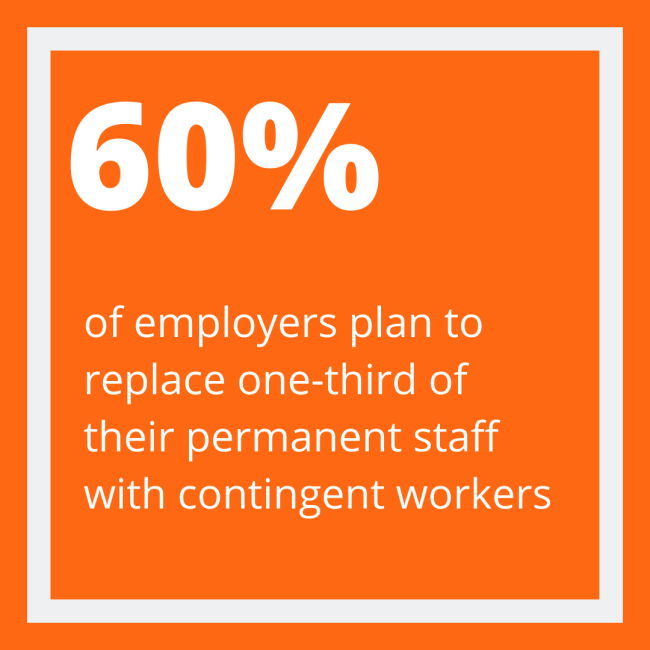
Next, there’s the type of worker to think about. Research from Intuit notes that 25-30% of the workforce is currently involved in ‘contingent work’ and this is expected to exceed 40% by 2020. A 2017 Randstad Sourceright report showed that more than 60% of employers had planned to replace one-third of their permanent staff with contingent workers. And according to KPMG’s 2018 CEO Outlook survey, almost all companies in the US (99%) are using a contingent workforce in some capacity.
As mentioned, in regards to the tech industry, many skilled tech workers are switching to contract work due to the higher rates they can command, but there is a good reason why employers are also choosing to employ more contractors both in tech and in other industries. In spite of the higher daily rates, employing contractors can actually be more cost effective because they’re not a member of staff and because they will only have to be paid for the actual length of the project.
It means companies can afford to take on someone with a niche skillset for a short period of time without worrying about whether or not they’ll need them after the contract has ended. It’s important to figure out whether a situation calls for a contractor or a permanent employee as there are benefits to both but it’s clear from the stats that employers are no longer shying away from contingent workers.
The fight for gender equality
In 2020, the Gender Pay Gap Information Bill is expected to come into effect, meaning that employers will be required to publish information relating to the gender pay gap among their employees and explain the measures being taken to reduce it.
In the UK, a similar law is already in action, with organisations with more than 250 employees publishing figures about their gender pay gap. Though no official date has been confirmed for Ireland’s reporting deadline, the Bill is still moving through the Oireachtas and a 2020 date is looking likely.
In Ireland, ‘Equal Pay Day’ in Ireland this year was 11 November 2019, meaning that due to the gender pay gap, women in Ireland have been effectively working for free that date until the end of 2019.
Of course, the reporting legislation alone will not be enough to mend the gender pay gap. In fact, recent UK figures show that the gap has actually widened slightly in 2019 among some groups. But the legislation imminent for Ireland, it’s a small step in the right direction because not only will companies with 250 or more employees need to publish and explain data in relation to their gender pay gaps, they will need to propose the measures they will take to close these gaps.
Once the legislation is enacted, and this will stretch to smaller companies in subsequent years. Therefore, it’s important for companies to start putting measures in place now, not only to gather the data, but to be honest about the gender gaps and start putting measures in place to close them for 2020.
Soft skills must not be forgotten in 2020
Finally, while industries are always evolving and jobs are always changing, it’s vital that employers and employees alike must not forget the importance of soft skills. As AI becomes more ingrained in our day-to-day jobs and lives, the skills and abilities that are most human are the ones that will be most important to the future workforce.
In fact, according to Udemy’s 2020 Workplace Learning Trends Report, “employees are leaning to their innately human skills and what robots can’t do”, which includes such attributes as critical thinking, storytelling and emotional intelligence. The report went on to say that the most in-demand soft skills in 2020 will include creativity, focus and having a growth mindset.
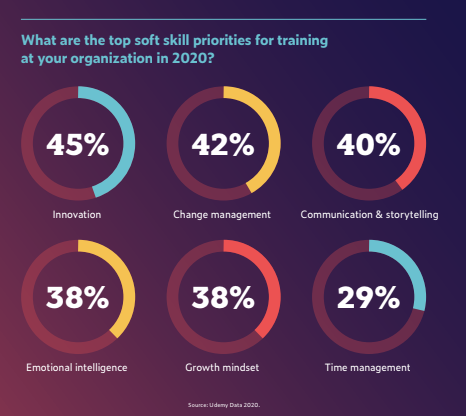
For employers, hiring based on soft skills can be the key to finding the right talent. Hard skills and technical capabilities must not be ignored but are much more trainable than soft skills such as communication, creativity and an innovative mind. These are the skills that can drive businesses forward.
Equally, employees need to make sure they are growing and expanding their soft skills as much as their technical skills. Not only that, but they need to be able to prove them in interviews and annual reviews. Being able to demonstrate genuine leadership skills, showing your ability to build relationships and applying your creativity to challenges in order to create solutions are all elements that will make candidates unique and difficult to replace. And in a highly competitive jobs market, it will be these candidates that will be most sought after.
Ready to find your place in the 2020 jobs market? Simply register your CV with us and/or create job alerts tailored to your specific career preferences. Sit back, and let us do the hard work on your behalf.