Most of us will spend one third or our lives in work, so it’s really important that you think about your career and make sure you are as happy as you can be with it. What success looks like is different for everyone. For some, it will be climbing the ladder as high as you can and get the most money. For others, it will be finding some sort of sweet spot, being financially comfortable without taking on too much responsibility.
You might want to find a career that gives you the flexibility to work from home or be your own boss. Or you might be content with always moving into new industries, always learning something new. Whatever success looks like to you, think about how you’re going to get there. Start by looking at your own job and the current situation you’re in. Ask yourself what your current job is doing for you. When you’re trying to figure out what makes you happy in your work, it’s important to look at what currently makes you happy as well as what might be missing.
Once you’ve done that, you can start making a strong career development plan for yourself. That doesn’t mean you have to start looking for a new job or change your career. The path you’re currently on could be exactly where you’re meant to be. But a good career plan will help you see that and show you where you’re heading and where you need to get to. The career development plan will most likely have some career goals at the end of it, but are you struggling to map out some of the small or medium-term goals that will get you to the big picture dream? Start with the next 12 months. What goals can you set yourself for the next year that will help you progress your career? Here’s how to set realistic career goals for yourself.
Once you’ve taken a long, reflective look at your current job, your career goals and what you need to do to be happy in that part of your job, it’s time to analyse your own abilities and skills a little more closely.
If you’ve done your career development plan, you may have already listed out all the skills you have and worked out where the gaps are, but it’s worth taking another look to see what skills are transferrable. Spend some time looking at job ads, both inside and outside your industry. Even if they’re not necessarily jobs you want to do, it’s still good to see how far your skills can take you and how you can apply them to other functions. Those skills are rarely only applicable to one thing and if they’re sought after in many roles spanning a number of different industries, then it’s important for you to know how valuable they can be.
On the flip side, it’s important to figure out how transferrable certain skills really are and to be honest about the gaps you might have or training you might need in order to truly transfer them. Project management skills are a great example of this. They’re extremely in demand and are necessary in a variety of vastly different industries. But can a project manager with 10 years’ experience move straight into technical project management? Quite possibly, yes. However, there are gaps in their knowledge and so they won’t necessarily be able to hit the ground running. You can read more about project management skills here.
You might also have a lot of knowledge in a certain area but no formal education and be worried that it might hold you back from getting a job in that area. In this case, online courses are a great place to start. Some are free or very inexpensive and can be easier to commit to due to the flexible nature of online learning. It can also be a good taster if what you’re hoping to upskill in is quite different to what you’re currently doing as it will give you a more solid idea about whether or not you want to commit to that line of study before investing a lot of time and money into a full degree. Here are 16 sites that will help you upskill online in a vast array of areas.
One area people often want to upskill into is coding, particularly as high tech and software engineering continue to grow and the need for talent increases. However, many people worry that because they’re already well into their own careers, that it’s too late to learn how to code. However, career changes are becoming more common all the time and anyone who is willing to put in the time, effort and dedication it takes to learn coding to a professional level is never too old. And like we said, the industry is still desperately seeking talent. Wondering if you need a degree to actually pursue a career in coding? Read more here.
A major part of your career plan could be about getting a promotion within your current company and this is a great goal to have. It’s often the easiest way to move up in your career because you’re learning and growing within familiar surroundings and even if the role is new, there’s a lot less of a learning curve because you don’t need to become familiar with a brand-new business. However, simply doing a good job isn’t always enough.
If you’re looking for a few tips to help you land that promotion faster, you need to communicate the good work you’re doing. You don’t have to brag on a daily basis, but it’s good to keep a log of your achievements and make sure the right people know about them. Speaking of the right people, you should also identify the star players within the business and spend more time with them. You can also advance your career with good body language. Of course, we’re not saying a decent handshake is enough to climb the ladder, but research shows that body language can have a major influence on interactions and relationships so it’s no harm to take note of your own body language. Want more tips to help you get promoted? Click here.
Career progression doesn’t always mean looking for that next big promotion in your company. Progression can take many different guises, such as taking on a new project, steadily and consistently improving your KPIs and engaging a mentor. Like we said, career success is different for everyone and so too are the ways they progress their careers. Even within different industries there can be different markers for career progression. For example, in the tech industry, progression is often about learning new technologies, even if it’s not what someone works with on a daily basis. However, the danger of upskilling outside formal experience, both in tech and other industries is being able to prove those skills. In fact, it’s a pitfall our consultants often come across. A tech candidate might have learned all about a new tool outside of their job but when it comes to proving it in their next job interview, it’s important to have tangible projects that can actually show off their new skills.
Career story: RECRUITERS’ Louise O’Reilly
Finally, for some, progression often means it’s time to look for a new job. If you find yourself disengaged with your own role, unable to progress where you are or you’re no longer learning new skills, it’s probably time to move on. However, it’s important to take stock of what you’ve learned in the role you’re currently in. Every job and every company can be a learning experience, even if it simply taught you what you don’t like or what you didn’t want. Make sure you recognise the skills you are now able to put on your CV that you weren’t before. Knowing the value of every employer is a major part of progressing your career, even if that progress does mean looking for a new job.
Once you’ve listened to all the signs that it’s time to look for a new job, you’ll need to know how to go about that job search. At all times, it’s a good idea to refer back to your career goals and development plan to identify what you want most out of a role. You should also take into account all the things you don’t want in an employer and see how best you can get the balance right.
If you want to find your dream job, you need to be extremely proactive and clever about your job search. You need to be proactive and your research well. Know the companies that align with your values. Know the roles that excite you. Find the jobs that bring those two elements together. These strategies will go a long way towards improving your job search. It’s also important to look out for markers of a good company on a more societal level. Is being kind to the environment important to them? What do they have to say about the gender pay gap? Are they a genuinely LGBTQ-friendly workplace? This isn’t always easy to find, but if you have a dream company that you want to work for and you don’t find enough satisfying information for what you’re looking for, don’t be afraid to challenge them on it. Remember, when you’re looking for a new job, you want to make sure it’s one that will make you happy.

While going through job specs and conducting online research is important, it’s also vital that you network. Talking to friends, family and former colleagues is a great way to find a job because they will listen to what you really want and, without agenda, know what is or isn’t right for you. They may also be in a position to actually put you forward for certain jobs and referrals are still considered an extremely strong resource for talent so hiring managers will want to know about you if you come from a referral. You should also remember to make the most of your LinkedIn profile – online networking is still networking after all. To find out more about why your personal brand on LinkedIn is important, click here.
Finally, for those who are a little more impatient than others, there actually are ways to speed up the job search if your really need to. Firstly, if you’re applying for any jobs that seem old, pick up the phone and find out if they’re still actively looking to fill it. For a start, it’ll stop you from wasting your time on jobs that are no longer available, but it will also alert hiring managers to you and they will most likely now be on the lookout for your CV. Find out more ways you can speed up your job search here.
Of course, you’re not going to be successful every single time, and maybe it will be a while before you get the job you really want. When that happens, there are three major points to consider, all of which relate to your mindset: Your attitude, deciding to take action and think about the fact that you join companies, not jobs. You can read more about how reset your thinking here.
Once your job search is a success and you’re offered a new job, it’s a huge step in your career, no matter what kind of move it is. However, there are a lot more steps to come on the road to your new job, starting with writing your resignation letter for your current role. It can feel daunting but when done well, it can really smooth the transition from old job to new job and help you leave your company on a good note. Our team of expert consultants have some top tips to write the perfect resignation letter right here.
When you hand in your notice, it might not be as simple as your boss accepting it and wishing you well in your new role. If you’re good at your job, well liked and your boss is smart, they will want to keep you in the building and will more than likely give you a counter offer. Ultimately, what you do with that offer is up to you. Maybe they’re looking to satisfy some of the problems you had with the job. You will almost definitely be offered more money, possibly a new position or new responsibilities that could satisfy your need to upskill and progress. Maybe you’ll get that flexibility you’ve always been looking for. However, in our experience, accepting counter offers can lead to murky waters. It’s important to remember why you’re leaving and question why you haven’t been able to get these shiny offers before you were ready to walk out the door. Perhaps your boss didn’t respect you enough before they realised they were going to lose you. Counter offers are not a good way to retain talent and candidates who went looking for greener pastures should bear this in mind. Wondering how to deal with the awkward counter offer?
By the time you’ve successfully moved on and you’re starting your new job, it’s a very exciting time but it can also be very nerve-wracking. In fact, the new job can be so overwhelming that you can often feel like you’ve made a mistake, which can really dampen the excitement. Don’t worry though, nerves, confusion, imposter syndrome and loneliness are all completely normal feelings when you start a new job, and even just knowing that can make you feel better.
However, it’s important to recognise the difference between normal feelings and red flags in a new job. Are you feeling out of your depth because you’re new or because the tasks you’ve been assigned are totally different to what was in the job description? Are your new colleagues unfriendly? Is the flexible working far less flexible than originally advertised? What if your new job genuinely isn’t what you thought it would be and you’re sure it goes beyond normal feelings of newness? Here’s what to do next.
Often in life, we need more than just a change of job, we need a career change. Based on how common job changes have become in recent years, it’s safe to assume that so too have complete career pivots. There are many reasons why it might be time for a career change for you. For instance, you might have simply fallen into your current career, with no real thought about how much you really want to do that job. Or you might have very consciously chosen it but have been doing it for an umber of years now and find yourself suffering from career burnout. There are plenty of reasons you might need to change your career, so if you’re not sure, check them out here.
Having said all that, changing your career can be quite a big decision, far bigger than changing job and that’s exactly what you have to think about. If you stayed on the same career path but made a few small adjustments, would you be happy or would you still find yourself growing tired of the career itself? You also need to take into consideration the external factors that might make you happy or unhappy. If a career change meant dropping €20,000 in salary to start at the bottom, would you be OK with that? These are just some of the things you need to consider before actually making a major career change.
Of course, not all career changes have to be radical. Some careers that appear to be drastic jumps actually have very similar undertones, which can make the transition much smoother. For example, a move from sales into a recruitment role can be an excellent fit because reaching targets, being in a customer-facing role and working in a fast-paced environment are all elements that both careers have in common. Want to read about someone’s move from retail into recruitment? Check out Eleanor’s career change story here.
So, once you’ve made the decision to change your career, what do you need to think about? Well, there are a few common mistakes when people pivot their careers, starting with acting without planning. Taking action is preferable to sitting around and waiting for your dream job to arrive, but the action must be well thought out to ensure success. It’s also important not to go through this career change alone. It’s a big step and you will need all the support you can get.
Career story: M&S Ireland’s finance director
Avoiding these mistakes is key, but so is doing the right steps. With that in mind, if you haven’t already done it in your career development plan, it’s time to do a thorough self-assessment first. Think about what skills you have and what really makes you happy and go from there. Once you’ve figured out what you want, do your research and figure out what you need to succeed. It’s also a good idea to find people who are currently doing the job you think you want. They can give you an honest opinion of the good and the bad parts of the job and help you make an informed decision. Want more tips for a successful career change? Click here.
One particular career change that people often overlook is a switch from traditionally permanent roles into contracting. For those who have never considered contracting before, it can seem extremely daunting leaving a permanent pensionable career track for the fluidity and uncertainty of fixed contracts and there are many myths about contracting that can make it seem scary too. For example, people often think it means there will be huge gaps in employment as the contractor finishes one contract and has to look for another. However, contractors are usually in touch with their recruitment company several months before the end of a contract with the intention to have work lined up straight away.
That’s not to say working as a contractor or a freelancer is all plain sailing. In fact, in 2018, we hosted a panel discussion in which we spoke to a number of professional freelancers about the highs and lows of their career paths. While it’s not a path you should take lightly, there are many benefits to becoming a contractor. For one thing, there’s so much more flexibility for contractors and for another, the nature of contract work means it’s more lucrative than permanent roles. While being a contractor also means that you won’t enjoy some of the perks that your permanent counterparts have access to, RECRUITERS contractors are catered to through our In-Life programme, additional benefits and annual BBQ, which you can check out below.
One particular area our expert consultants have noticed flourishing in the contracting division is finance roles. Traditionally, the contingent workforce was associated with the tech industry, but more industries are looking to take advantage of the benefits a contract workforce provides, the finance and accounting industry in particular. In fact, in 2017 PwC estimated that the finance industry was made up of around 30-40% contingent workers.
However, finance professionals are naturally risk adverse, which worsens the talent shortage. However, it also means candidates who would consider moving into the contracting space, even for a short time, could benefit hugely from the move. Because of the unique nature of contract finance work and the continuing need for highly skilled financial professionals in both contract and permanent roles, there’s never been a better time to reap the rewards of making a switch to contracting in finance.
Career story: Dixons Carphone’s head of finance
So, you’re thinking about becoming a contractor for the first time. What do you need to do? It’s important that you’re prepared. While lucrative, flexible and incredibly rewarding, it’s not as simple as quitting your job and starting your first contract role. You need to figure out your area of expertise before going in blind. You also need to have a financial plan in place, especially if you’re moving in to contracting for the first time. You also need to think about how you market yourself because that’s every bit as important as having a financial plan in place. Our contract division manager Sarah Pope shares more advice for new contractors here.
Of course, you don’t have to be on the lookout for a new job or a major career change to make sure you’re happy at work. There are a lot of day-to-day issues at work that can make your day that little bit harder. It’s not good to dread work every single Sunday, but that doesn’t mean we’re not going to admit that Mondays are hard.
So, ensuring you’re your job and your career makes you happy isn’t just about looking for the job. In fact, it’s all too easy for us to constantly say “I’ll be happy when…” So, what, could you do to make work a little easier? Is you commute getting you down? Is there a way to negotiate a little more remote working in your week with your manager? Do you struggle with dealing with conflict at work? This one can be particularly important because managing conflict is an excellent skill to have and not only will it make your current work life easier, but when you do decide to move on, it will make an interview question about conflict much easier to answer. For top tips on managing conflict, we spoke to three small business owners to learn how they do it. You can find out how they deal with conflict at work here.
Maybe you could use some more time management skills to work a little smarter on the job. Being more efficient can often keep you energised, engaged and happy at work. Additionally, if you’re on top of your time management, you will most likely reduce your stress levels. Career expert and entrepreneur Penelope Trunk advises experimenting to find out what works best for you. There are plenty of broad, well-meaning time management advice on the internet but she says it often doesn’t take into account the reality of most people’s lives including family. Find out how she advises managing time without wrecking your family’s heads here.
Perhaps you’re content at work but you’d like to increase your productivity a little – without working harder or staying later, that is. Good productivity is about working smarter, not harder and it involves taking regular breaks to keep your brain fully engaged on each task. It’s also good to have to-do lists to keep yourself from falling into an email rabbit hole or put off jobs you don’t want to do. Want more productivity tips? Click here.
Maybe you’re extremely happy in your job, satisfied with the path you’re on and enjoy what you do every day and if so, that is fantastic. But you’d be forgiven for finding the day after a bank holiday difficult. Don’t worry, we’re not here to judge, we’re here to help. Here’s how to get through the day (and week) after a bank holiday weekend.
A major part of making your job and your career as a whole work for you is to have good work-life balance. As a society, we are now working harder than ever before and with more technology connecting us to our working lives at home too, it’s becoming more difficult to disconnect from work.
Despite our goals towards maximising our productivity, overworking can actually lead to a lack of productivity, severe stress and, in some cases, burnout. In fact, a recent report on workplace wellbeing shows that distressed employees spend more than a third of their time at work being unproductive and, on average, one full day off sick per month.
It might sound like a buzzword, but work-life balance and workplace wellbeing is vital for both your physical and mental health and should constantly be at the top of your career goals every year. Did you work a lot of overtime this year? Are you getting enough sleep? Do you feel able to switch off outside of work? These are all questions you need to regularly ask yourself as check-ins because even if you have your dream job, you can’t enjoy it if you’re burnt out. If you’re in a bad habit of working overtime, below are some tips on how to avoid it.
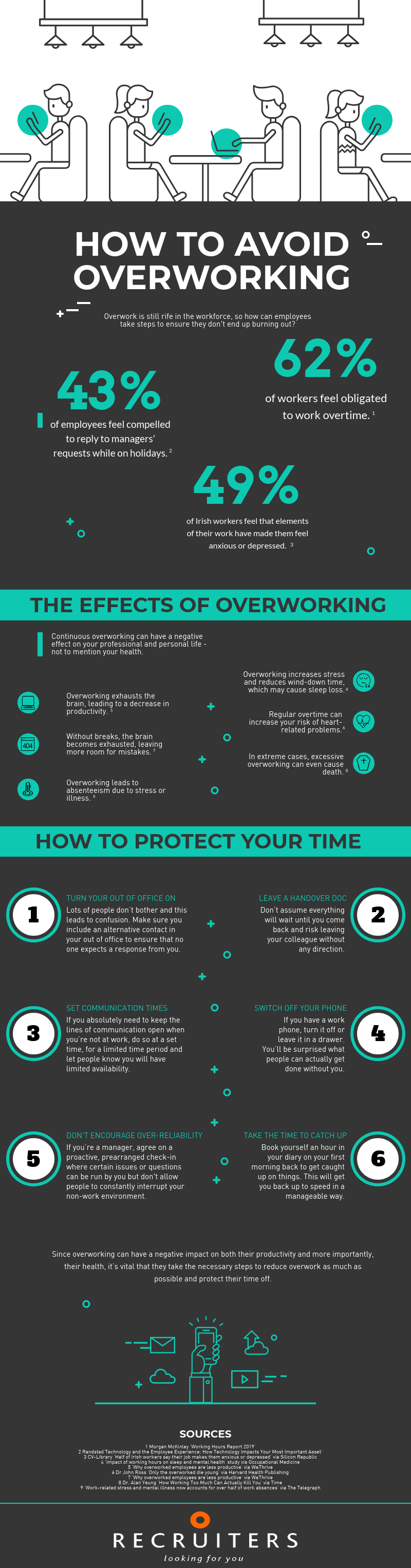
It’s not enough to just work within the confines of your contracted working hours, you have to take steps to reduce workplace stress as well. A stressful work environment can contribute to problems such as headaches, stomach aches, sleep disturbances and burnout, which the World Health Organization classified as a legitimate diagnosis in May 2019.
So, how can you manage your stress levels? Getting regular exercise and regular sleep, spending time with loved ones and going for walks are all important when it comes to managing stress levels. If you’re in the thick of stress and anxiety at work, good mindfulness and meditation practices such as deep breathing exercises can help your body calm down from its ‘fight or flight’ response. Want to know how the RECRUITERS team deals with stress?
Not only is it important to manage your own stress levels, but if you’re a people manager, even of just one other person, you have a duty of care to that person and will need to watch out for signs of stress and burnout. We spoke about this in an episode of the RECRUITERS Review podcast in 2018. You can listen to the full episode here.
Whether you’re just starting out in your career, at C-suite level or right in the middle and thinking about a career change, everyone needs to take stock of where they are regularly, make sure they’re as happy as they can be and maintain positive, healthy workplace practices to ensure they stay happy.
For some, happiness in your career might mean it’s time for a change, and RECRUITERS can help you with that. Simply register your CV with us and/or create job alerts tailored to your specific career preferences. Sit back, and let us do the hard work on your behalf.
Compass photo by Jamie Street on Unsplash